Khanqah-e-Molla

A Wooden Masterpiece that Breathes History
Tucked away in the winding lanes of Downtown Srinagar, where the Jhelum River makes a quiet bend near Zaina Kadal, stands a majestic wooden monument, Khanqah-e-Molla. The building, crowned with a green pyramidal roof and adorned with intricate woodwork, might seem just another old shrine to a passing tourist. But for those who know its story, every beam and panel carries the legacy of a saint, a scholar, a traveler, and a reformer, Mir Sayyid Ali Hamadani, or Shah-e-Hamdan (RA).
This shrine is not merely a building, it is the spiritual cornerstone of Islam in Kashmir.
The Story Before the Shrine: Who Was Shah-e-Hamdan (RA)?
Born in Hamadan, Iran, in 1314 CE into a family of Sayyids (descendants of the Prophet Muhammad), Shah-e-Hamdan (RA) was surrounded by scholarship and spirituality from an early age. He received deep training in Islamic jurisprudence, logic, metaphysics, mathematics, astronomy, and Sufism but his soul belonged to the path of the Kubrawiya Sufi order, known for its emphasis on inner purification and societal reform.
But Shah-e-Hamdan (RA) was not content staying in one place. He was a seeker of souls, not thrones. He traveled widely from the Central Asian cities of Bukhara and Samarkand, to Mecca and Medina, and eventually, to Kashmir.
He arrived in Kashmir for the first time in 1372 CE, at a time when the region was politically fragile and religiously diverse. Kashmir was ruled by Sultan Shihab-ud-Din, who welcomed the scholar warmly. The valley was predominantly influenced by Shaivism and Buddhism, but there was an intellectual and spiritual curiosity among its people.
Islam Arrives in Kashmir: Through Spirit, Compassion, and Reform
In Kashmir, Hazrat Mir Sayyid Ali Hamadani (RA) is revered as the saint who spread the message of brotherhood, based on principles of Quran and Sunnah in the region and also introduced many crafts and art forms in the valley. Among his many writings, the most well-remembered are a devotional prayer, Awrad-i Fathiyyah; a collection of his poetic verses called Chihil Asrar and a treatise on objectives towards good governance called Zakhirat ul Muluk.
He respected existing faiths and never positioned his beliefs in opposition. Instead, he offered guidance through action, living a life that reflected integrity, humility, and service. His approach wasn’t about power or persuasion, it was about uplifting communities, encouraging education, ethical living, and self-reliance.
Shah-e-Hamdan (RA) didn’t give fiery sermons; he quietly transformed hearts.
He didn’t establish dominance; he built institutions, supported artisans, and empowered the poor.
He didn’t demand devotion; he earned it through compassion, knowledge, and example.
Through his teachings and actions, Islam found a natural place in the cultural and spiritual fabric of Kashmir as a faith that valued coexistence, learning, and social justice.
The 700 Disciples Who Changed Kashmir’s Future

Shah-e-Hamdan (RA) wasn’t alone. With him came 700 of his disciples and they weren’t just spiritual aspirants. They were skilled artisans, scholars, engineers, weavers, and administrators.
Weavers and dyers introduced fine wool techniques that gave birth to Kashmiri Pashmina and Sozni embroidery.
Architects and carpenters introduced Persian motifs that blended with local temple architecture to form Kashmiri-Islamic design.
Calligraphers and scholars brought knowledge systems that seeded Islamic education in the valley.
He urged artisans to teach their craft to locals, ensuring the economy of Kashmir blossomed through self-reliance and skilled labor. What you see in Kashmir today its intricate woodwork, the paper-mâché art, the woven rugs and copperware all trace some lineage back to this cultural infusion.
The Building of Khanqah-e-Molla: Shrine of Light
When Shah-e-Hamdan (RA) departed from Kashmir, he left behind an impact so deep that Sultan Sikander (1389–1413 CE), one of the early Muslim rulers of the region, decided to immortalize his memory. In 1395 CE, the first Khanqah (Sufi lodge) was constructed on the very spot where the saint used to meditate and preach on the banks of the Jhelum.
Unfortunately, like many wooden structures, it was damaged by fire multiple times first in the 15th century, and later in 1731. But each time, it rose again, lovingly restored by those who revered Shah-e-Hamdan (RA). The current version was built by Abul Barkat Khan and still retains the Persian-Kashmiri architecture first introduced by the saint’s entourage.
Spiritual & Cultural Significance of Khanqah-e-Molla
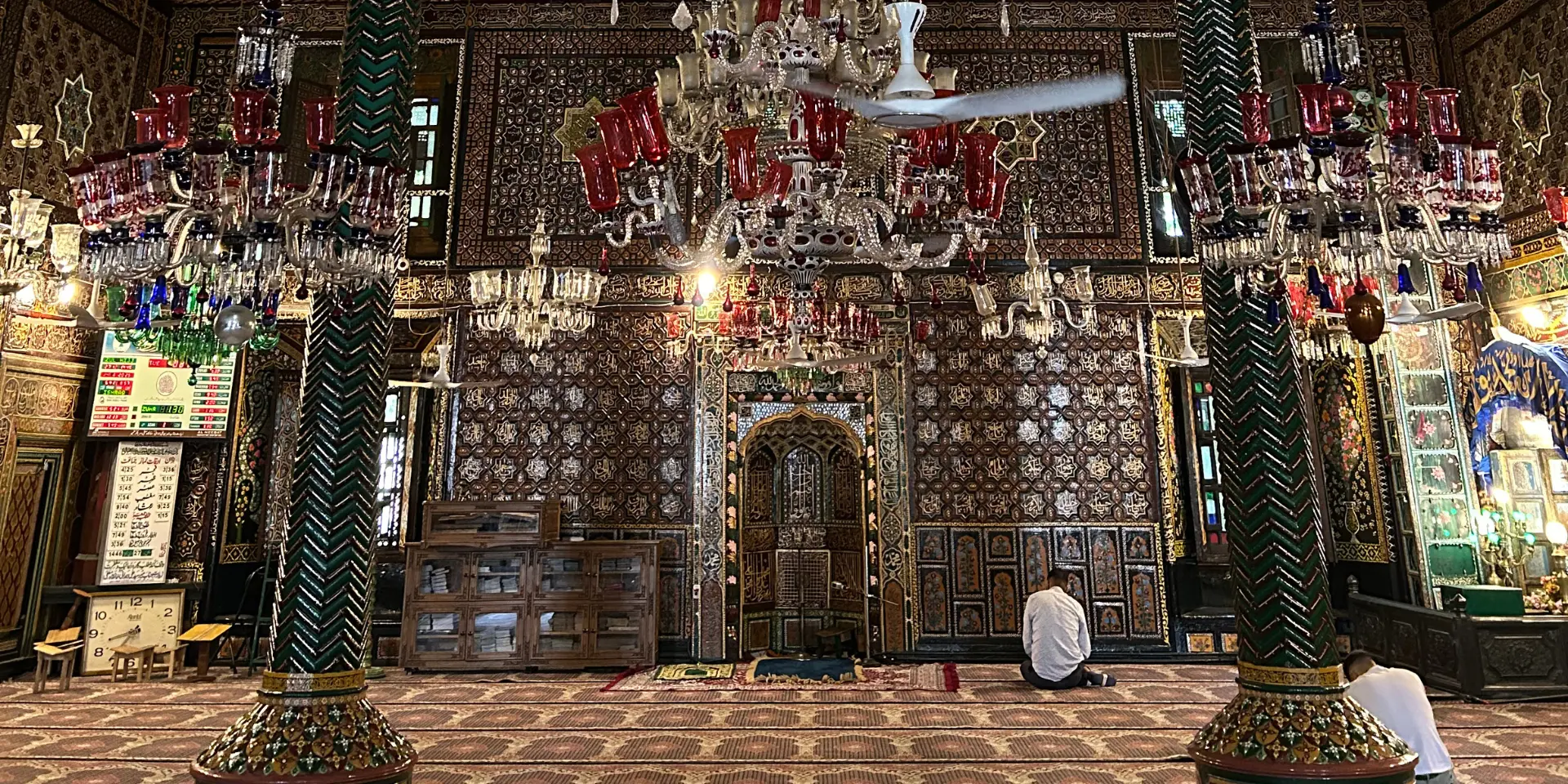
The Khanqah-e-Molla is more than just a mosque it is a living example of Sufi philosophy in practice. It was not only a place of prayer, but a center of spiritual education, a shelter for travelers, a court for community disputes, and a hub for music and poetry inspired by divine love.
Even today, the Friday congregations at the Khanqah are emotionally charged events. The walls still echo with qasidas (odes) and na’ats (poetry in praise of the Prophet), recited in the memory of Shah-e-Hamdan (RA) and the Sufi saints.
Inside the shrine, the papier-mâché ceilings, floral paintings, and carved wooden panels transport you into another era. The fragrance of burning oudh (agarwood), the soft murmurs of prayers, and the sound of the river outside complete the experience.
Where Is Shah-e-Hamdan Buried?
Contrary to popular belief, Shah-e-Hamdan (RA) is not buried in Kashmir. After completing his mission, he returned to Central Asia and passed away in Kunar, Afghanistan in 1384 CE. His body was later taken to Khatlan (in modern-day Tajikistan) where he was finally laid to rest.
His tomb, known as Mazaar-e-Ali Hamadani, located in Kulob, Tajikistan, is still visited by pilgrims and remains an important Sufi site in Central Asia.
Yet, in many ways, his spiritual legacy is more alive in Kashmir than anywhere else. In the Kashmiri ethos of compassion, hospitality, aesthetics, and craft, one can find the lingering influence of the Persian sage.
Travel Tips for Visiting Khanqah-e-Molla
Located in Zaina Kadal, Old Srinagar. Best visited in the morning or just after Zuhr (afternoon) prayer.
Dress modestly, carry a scarf or head covering.
Photography of the interior may be restricted; seek permission.
Explore nearby heritage lanes for local handicrafts, copper utensils, and street food.
Final Words: A Shrine that Transcends Time
To walk into Khanqah-e-Molla is to walk into a living memory; one that bridges 700 years of Kashmiri culture, Islamic history, and Sufi spirit. It is not just a monument. It is a prayer in wood, a philosophy carved in space, and a legacy that lives not in tombs, but in the ethics, aesthetics, and soul of a people.
Looking to explore the soul of Kashmir beyond the tourist trails? Join Wildfloc’s Downtown Heritage Tours, Sufi Trails, and Craft Walks to experience Srinagar like never before.
Click here to explore Things to Do in Kashmir with Wildfloc